Monday, April 28, 2014

Brass Choir Repertoire

Today we discussed repertoire that might be appropriate for a collegiate brass choir. As I mentioned, there are often several challenges to forming a brass choir; repertoire, scheduling, and instrumentation to name a few. Below is a list of suggested original works for brass choir you might consider. There are many excellent arrangements of works by Wagner, Strauss, Rimsky-Korsakov, et. al, but I focussed on original works. 


Fisher Tull - The Binding, Commendation, Liturgical Symphony, Quodlibet, Soundings, Variations on an Advent Hymn

Alfred Reed - Symphony for Brass and Percussion, Othello; Symphonic Portrait for Brass Ensemble

Aaron Copland - Fanfare for the Common Man, Ceremonial Fanfare

Karel Husa - Divertemento

Walingford Riegger - Music for Brass Choir, Op.45 (1949, Nonet for Brass (1951)

Guther Schuller - Symphony for Brass and Percussion (1950)

Raymond Premru

Joseph Turrin

Hovhaness - Link to List of Wind and Brass Music

Eric EwazenSymphony in Brass, A Western Fanfare, Grand Canyon Sinfonia, Front Range Fanfare

David Felder - Incendio, Shredder

Editions BIM - Music for Brass Ensemble (including works by Howarth, Koetsier, Plog and Sampson)


We also listened to parts of my YouTube playlist "Brass Choir Music". I have embedded the whole playlist here:

Wednesday, April 23, 2014

Obscure Brass Day

In class today, we held an"Obscure Brass Ensemble Music Day" listening session and each of you made excellent contributions. Interpreting the word "Obscure" as less frequently heard, or known by few, we came with an eclectic and innovative mix. Since most of them are on YouTube, I have curated them all onto a YouTube playlist called, of course, "Obscure Brass"

Monday, April 14, 2014

Henri Tomasi - Fanfare Liturgiques

Tuesday we listened to the Summit Brass recording of Fanfares Liturgique, by Henri Tomasi. As you heard, it is a very powerful and well-crafted composition. The names of the movements are translated below, and as we discussed, the genre seems to be an "instrumental oratorio" - that is, a sacred brass choir version of a liturgical work. Of course there is no text sung, but the orator could be represented by the trombone solo of the second movement. Note also the return of the triumphant first theme, possibly a motif for the Christ figure, returns in the final movement. I also was reminded in several passages of the works Stravinsky, Respighi, Bach, and Dukas.

This work was originally called "Fanfares Concertantes" and was part of his opera Don Juan de Mañera.
  • I. Annonciation (Annunciation is the term describing the moment when the angel Gabriel declared Mary to be the mother of God)
  • II. Evangile (Gospel, or the word of God)
  • III. Apocalypse (Apocolypse, or revelation?) Four Horsemen who are listed as Pestilence (disease epidemic), War, Famine, Death
  • IV. Procession du Vendredi-Saint (Good Friday Procession, a Christian celebration commemorating the crucifixion of Jesus)
For more information about Tomasi, go to the Tomasi page and for more listening, go to Tomasi on Naxos.


More About Tomasi and his Contemporaries

Henri Tomasi
At our recent listening session to Fanfares Liturgiques, composed in 1947 by Henri Tomasi, I commented on hearing the influence of several composers with the piece; including Copland, Respighi, Stravinsky and Dukas. Below are the dates of these composers, as well as a list of other contemporaries of Tomasi's for comparison.

Henri Tomasi (1901-1971)
Aaron Copland (1900-1990)
Ottorini Respighi (1879-1936)
Igor Stravinsky (1882-1971)
Paul Dukas (1865-1935)

OTHER CONTEMPORARIES:
Stockhausen, Shostakovich, Britten, Crumb, Hindemith, Babbitt, Barber, Ives, Prokofiev, Varese, Boulez, Arnold

FAMOUS COMPOSITIONS OF 1947-1952:
4'33" by John Cage - 1952
Trumpet Concerto by Arutiunian
Knoxville: Summer of 1915 by Samuel Barber


TOMASI BIOGRAPHICAL SKETCH:
(from http://www.henri-tomasi.asso.fr/en/index)

I. A young Corsican from Marseille (1901-1920)

1901 – August 17. Henri Tomasi, the first son of Xavier Tomasi and Joséphine Vincensini, both from La Casinca, Corsica, is born in a working class neighborhood of Marseille called ‘La Belle de Mai’, at 17, rue Bleu (now called Rue Clovis Hugues).

1905 – The family moves to Mazargues, where Henri’s father has a job as a postal worker. Himself an amateur flutist, Xavier sends his 5-year-old son to musical theory lessons.

1908 – Henri enters the Conservatoire de Musique de Marseille. He wins first prize for musical theory when he is ten and first prize for piano at thirteen. His father takes him to visit upper class families where, introduced as a musical wunderkind, he feels ‘humiliated to be on show like a trained animal.’

1913 – The family moves back to Marseille, 5, Rue de la Loubière, next to the Notre-Dame du Mont church. Whenever he can, the boy skips classes at the conservatory and goes swimming or reads Les Pieds Nickelés in secret in response to the strictness of a father who has brushed aside his dream of becoming a sailor.
Every summer he travels to Corsica where he learns traditional Corsican songs from his grandmother.

1916 – First prize in harmony theory shared with Zino Francescatti [the celebrated violonist], who becomes his friend. As WWI has delayed his entry into the Conservatoire de Paris, he begins earning money in Marseille as a pianist. He plays in the most diverse settings imaginable: stylish, well-known establishments such as l’Hôtel Noailles or the ‘La Réserve’ restaurant on the cliff road; the brothels ‘Chez Aline’ and ‘Chez Adèle’; and the first movie houses, ‘Le Femina’ and ‘Le Saint-Ferréol.’ His gift for composition is obvious when he improvises on the keyboard. The earliest Charlie Chaplin films and ‘The Mysteries of New York’ awaken his interest in cinema.
Jean Molinetti, life-long best friend and confidant, recalls having heard him play one of his first pieces, ‘Au Bord du Djedi’, during this period.

II – Studies and early accomplishments in Paris (1921-1938)

1921 – Arrival in Paris and enrolment in the Harmony Class at the Conservatoire de la Rue de Madrid. He is a brilliant student – “He showed up with a fugue a week. He was indefatigable – an inveterate workaholic!” his friend Maurice Franck would say. Although he has a scholarship from the municipality of Marseille and is under the patronage of the lawyer Maître Lévy-Oulman, he is obliged to continue ‘doing the job’, that is, playing piano in cafés and cinemas, in order to get by.

1925 – His first piece, a wind quintet called Variations sur un Thème Corse, wins the Prix Halphen.

1927 – He meets Odette Camp at the Opéra-Comique. The 18-year-old, a student at the Beaux-Arts, has come to discover Puccini’s La Bohème. This is also the year when Henri Tomasi receives the highest possible honors: a Grand Prix de Rome and a First Prize for Orchestra Conducting, awarded unanimously.

1928 – He begins his career as an orchestra conductor with the ‘Concerts du Journal’, and writes a piece for piano and violin, Paghiella, first performed by Zino Francescatti.

1929 – In Loretto di Casinca, Corsica, where his family’s roots are, he composes Cyrnos, a symphonic poem for orchestra and piano. According to Florent Schmitt, “Cyrnos contains original ideas, inspiration and, lastly, a dash of lyricism, so rare amongst young people nowadays.”
On October 30, in Paris, he weds Odette Camp, who is to become an accomplished artist. They settle down near Pigalle, at 24 Rue Victor Massé.

1931 – He conducts the ‘Radio-Colonial Orchestra’ founded by Julien Maigret during the 1931 Colonial Exhibition in Paris, thus becoming one of the first radio conductors and a pioneer of ‘radiophonic music’. His renown is secured by the public appreciation of Tam-tam, a symphonic poem for Choir, Solo and Orchestra.

1932 – Tomasi becomes a founding member of the ‘Triton Group of Contemporary Music’ along with Honegger, Milhaud, Poulenc, Prokofiev, and others. The Honorary Members include the 20th century’s most illustrious composers: Ravel, Stravinski, Schoenberg... He composes a new work that reinforces his renown, Vocero, a choreographed symphonic poem with a Corsican perspective.

1933 – Chants Laotiens for baritone or contralto and orchestra or piano.

1935 – Quatre Chants de Geishas for soprano and orchestra or piano. His recording of Gluck’s Orphée featuring Alice Raveau is awarded the Grand Prix du Disque.

1936 – Increased activity as a conductor in Paris and the rest of France.

1937 – He writes his first work inspired by Provence, southeast France: a ballet called Les Santons. With its libretto by René Daumesnil, the piece, first performed at the Opéra de Paris on November 18, 1938, is a great success. In 1946 it is recorded on film for posterity.

1938 – He composes the Ballade pour Saxophone Alto, first performed by Marcel Mule in 1939.

III – Second World War – global and personal crises (1939-1944)

1939 – In the midst of an existential crisis, he yearns to get away from it all. He boards – alone - a cargo ship destined for Dakkar but the Second World War breaks out, and as soon as Henri arrives in Morocco he has to return to France. He is drafted on August 15 and joins the Chasseurs Alpins at the fort of Villefranche-sur-Mer where he is named Head of the Marching Band.

1940 – Discharged, he once again takes up his conductor’s baton at the Orchestre National, which has been expatriated to Marseille. Reunion with his family and his wife Odette who leaves Paris to join him. The couple settles down on the cliff road, 151 Corniche, where they frequently entertain. Their friends and guests include musicians such as Etienne Baudo and Joseph Alviset, the writer Roland Dorgelès, the photographer Gaston Manuel and many others.

1941-42 – The Symphonie en ut (C major), conducted by Charles Munch, heralds a new period, both in his way of thinking and his musical compositions which reflect a new breadth. “The battle between the instinct of passion and mystical yearnings – the sufferings of humanity – the final affirmation of enduring joy.” He begins spending time at the Monastère de la Sainte-Baume (which is Dominican at the time) in order to devote all his energy to creating the opera that would become his chef-d’oeuvre, Don Juan de Mañara, based on the fine text by poet O.V. de L. Milosz.

1943 – His life is divided between Marseille and Sainte-Baume. He and a young woman fall in love, but as there is no hope of establishing a relationship, he spends more and more time in religious retreats. La Presse wonders “whether Tomasi is going to take orders”. Odette, his wife, thinks that he had better not, and she manages to transform the meeting where Henri has come to ask for a divorce into a reconciliation...

1944 – Birth of their son, Claude Tomasi. Henri finishes composing his Requiem pour la Paix, dedicated “To the martyrs of the resistance movement and all those who have died for France.” At the end of the war, the discovery of the concentration camps and Hiroshima leads the musician to reject all faith in God and religion, and he sets his Requiem aside. It isn’t until 1996 that the musicologist Frédéric Ducros-Malmazet rediscovers the opus and it is finally recorded. Played by the Orchestre Philharmonique de Marseille and the regional choir of Provence-Côte d’Azur under the direction of Michel Piquemal, the requiem is undeniably a masterpiece.
IV – Parallel Careers throughout Europe (1945-1958)

1946 – Raoul Gainsbourg appoints him Directing Conductor of the Opéra de Monte-Carlo, heralding a brilliant and intense new period of activity guiding orchestras throughout France, including the Orchestre National, the various radio orchestras, and Concerts Pasdeloup, Colonne and Lamoureux. His activity in the rest of Europe kicks off with a triumphant performance conducting a Debussy-Ravel program with the Concertgebow Orchestre in Switzerland. He’ll be invited back several years in a row (the Holland Festival).

1947 – First performance in Monte-Carlo of what will become one of his most famous works. Originally called Fanfares Concertantes, the opus will be played world-wide in its integral form under the name Fanfares Liturgiques. Its four movements, Annonciation, Evangile, Apocalypse and Procession du Vendredi Saint, are part of the opera Don Juan de Mañara.
First season with the Festival de Vichy where he will conduct until 1955.

1948 –Henri Tomasi writes what will become his most popular composition, Le Concerto pour Trompette. It will be played and recorded by some of the finest musicians of the time: L. Vaillant, M. André, P. Thibaud, W. Marsalis, E. Aubier...

1949 – Concerto de Saxophone: first performed in Paris on March 2, 1950, by Marcel Mule. Tomasi himself conducts the Orchestre National.

1950 – Concerto pour Alto.

1951 – Divertimento Corsica.
Based on the novel by Pierre Benoit , l’Atlantide, with libretto by Francis Didelot, is a choreographed operatic drama that has an exceptional destiny. It will be performed over eighty times in France (twenty at the Palais-Garnier in Paris), Germany and Belgium.

1952 – In February a serious automobile accident resulting in a broken leg interrupts his conducting career for several months.
He writes his Noces de Cendres (The Ashen Wedding), an anti-war ballet, and is awarded the Grand Prix de la Musique Française by the SACEM.

1953 – The lyrical drama Sampiero Corso, with libretto by Raphaël Cuttoli, is first played in May,
1956, in Bordeaux starring Régine Crespin. It is performed at the Holland Festival the same year.
There are initial signs of deafness in the right ear, a malady that will deteriorate until his hearing is definitively lost in that ear.
He declines an invitation to join the Légion d’Honneur, “until such time as a Conservatory is founded in Corsica.”

1955 – Triomphe de Jeanne, an oratorio, with text by Philippe Soupault. To mark the five hundred year anniversary of Joan of Arc’s rehabilitation, it opens in Rouen in 1956 featuring Rita Gorr and Ernest Blanc.

1956 – April 12 heralds the triumphant world premiere in Munich of Don Juan de Mañara.
He writes the Concerto pour Clarinette and the Concerto pour Trombone.

1957 – Tomasi leaves conducting both in order to devote his energy entirely to composing and also because of various physical problems.

1958 – The overwhelming popularity of l’Atlantide, performed at l’Opéra de Paris, makes Tomasi the scapegoat of the ‘musical avant-garde’, particularly sectarian at the time. It is during this same period that misgivings about his former way of thinking and use of language lead him to a new phase of inspiration and creativity.

V – Oblivion and metamorphosis (1959-1971)

1959 – Le Silence de la Mer, a lyrical drama in one act based on a text by Vercors, marks the beginning of a phase where the very soul and history of the 20th century would be embodied in powerful opuses with a decidedly contemporary slant. This chamber opera, recorded at the ORTF by Georges Prêtre, will first be played in germany at the Opera of East Berlin in 1966.

1960 – Grand Prix Musical awarded by the city of Paris.

1961 – Ulysse ou le Beau Périple (Ulysses or the Beautiful Journey), ‘a literary and musical diversion’, is composed based on a text by Jean Giono.

1962 – Tomasi’s Concerto pour Violon (’Ulysses’ Journey), dedicated to and first perfomed by Dévy Erlih, is described as “a piece of fabulous, epic expressionism” by the critic from “Le Monde”, Jacques Lonchampt.

1963 – La Chèvre de Monsieur Séguin, a lyrical tale based on A. Daudet’s narrative, is recorded starring the well-known actor Michel Galabru.

1965 – Concerto pour Flûte (Printemps). The opening performance in Marseille, January 1966, features Jean-Pierre Rampal and the Orchestre des Concerts Classiques conducted by Serge Baudo.
His Éloge de la Folie (ère nucléaire) – ‘In Praise of Madness (the nuclear era)’, based on a piece by Erasmus, is described as “the interplay of satire, lyricism and choreography”. This opus, the last he creates for theater, echoes the testament that Tomasi will first write in 1966: “E finita la commedia! Peace, finally, on this stupid planet!”

1966 – He composes Retour à Tipasa, “a secular cantata for spoken voice, male chorus and orchestra”; text by Albert Camus. The opening performance won’t be held until after his death at the Abbaye de Saint-Victor on April 25, 1985. The piece goes beyond the absurd to celebrate communion with the world and solidarity among men. “In the heart of the winter I finally realized that part of me was an invincible summer. Oh light! Oh vibrant light!”.
His Highlands’ Ballad, a concerto for harp, will be recorded in 1985 by Marielle Nordmann and the Orchestre de Chambre des Solistes de Marseille under the wand of Reynald Giovaninetti.

1967 – Tomasi’s indignation with political and social injustice is transcribed into the core of his compositions, especially his Symphonie du Tiers-Monde (Third World Symphony), based on a text by Aimé Césaire and dedicated to Hector Berlioz.

1968 – Chant pour le Vietnam, a symphonic poem inspired by a texte by Jean-Paul Sartre, is written to accompany a photo exhibition by Roger Pic.
Concerto pour Violoncelle. - Tomasi does not obtain the authorization to write musical adaptations of Ionesco’s The Chairs or The King is Dying.
His Concerto de Guitare à la Mémoire du Poète Assassiné, F.G. Lorca, originally conceived for the Duo Presti-Lagoya’s two guitars, is rewritten for guitar solo after Ida Presti’s death.

1969 – He holds a series of interviews with his son, Claude, called “Autobiography with a tape recorder.”
On November 1 he is afflicted with pulmonary edema. After ten months of convalescence, Henri Tomasi will finally be able to see the Vieux-Port de Marseille for the last time in September, 1970. “Before the final breakdown, I must see the Mediterranean, my sea. Vive mare nostrum!”

1970 – “Back in exile” in Paris, he adds the finishes touches to a Concerto for Contrabasse and rereads Hamlet with the idea of putting the plot to music. Time runs out, and he will only be able to finish the a cappella score of the twelfth of his 18 Chants Populaires de l’Île de Corse.

1971 – On the morning of January 13, he dies suddenly and peacefully in his apartment in Montmartre. In accordance with his last wishes, he is buried under the Mediterranean sky in his wife’s family tomb in Avignon. The simple ceremony, “without flowers or wreaths, nor civil or religious ceremony,” is attended solely by family members and Jean Molinetti.
In 2001, to celebrate the centennial of his birth, his ashes are moved to the village of his forebears, Penta di Casinca, in Corsica.

Thursday, April 03, 2014

Group Listening Session

La Brass Banda
Yesterday morning we all contributed to a group listening session. Here is what we heard:

1. "Insomnio" by Jon Nelson for large brass ensemble. The group/CD name is "Metalofonico" and the personnel included members of the Meridian Arts Ensemble, the Atlantic Brass Quintet plus Greg Evans and Jeff Scott on horn; Stephan Sanders, Jim Miller and Miles Anderson on trombone plus percussion. Here is a link with more information about the recording.

2. Ben Yates played two recordings of the Chicago Symphony Brass section (Gabrieli and Berlioz). Here is a grooveshark link where you can listen to the tracks.

3. Ben Drury showed a video of Kudt Brass performing Don Quichottisen by Jan Koetsier (Op. 144) Watch the rest of the video here.

4. Randil played a recording of a work for brass band by Paul Lovatt-Cooper called "Enter the Galazies" by the Corey Band. Here is a video.

5. Chris played a video of the Vienna Horns performing/recording of an arrangement of Back to the Future from their CD "Director's Cut" (composed by Alan Silvestri and arranged by ?)

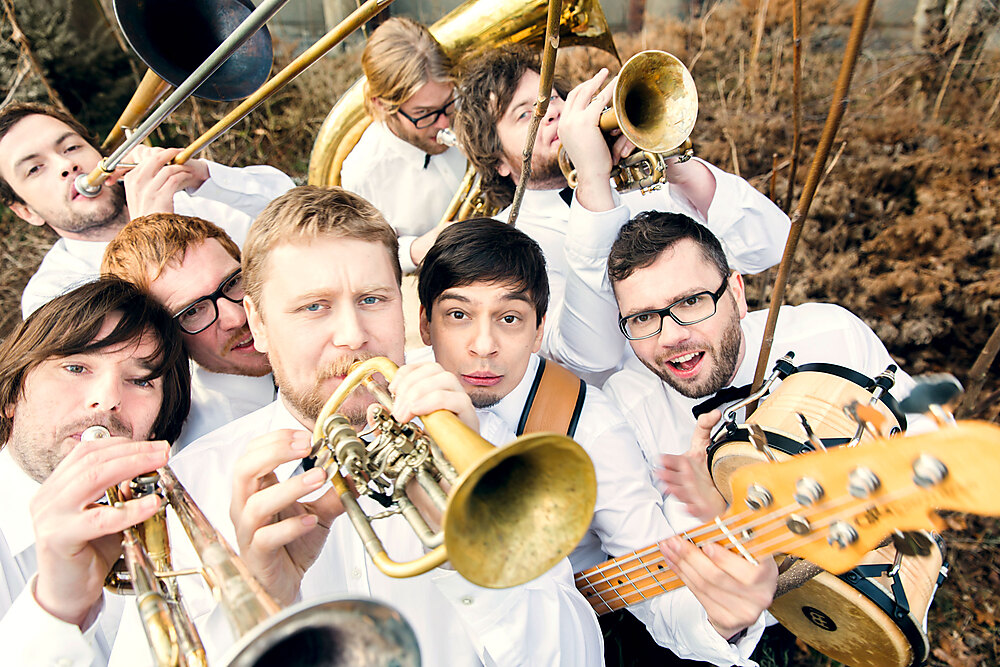
6. Zsolt presented a video of a unique popular brass band from Bavaria called "La Brass Banda". Here is a link to the video.

Thank you all for your contributions to this interesting and diverse listening session! 

Monday, March 31, 2014

Symphony for Brass by Malcom Arnold

Sir Malcolm Arnold (left) with Denis Egan
on natural trumpets in 1946
Today we listened to Sir Malcom Arnold's Symphony for Brass as recorded by the Philip Jones Brass Ensemble. The piece was written in 1978 with the PJBE standard instrumentation of four trumpets, one horn, four trombones and one tuba. We discussed some theories of why this instrumentation came about. It may have had something to do with the fact that the PJBE originated as a brass quintet.

Arnold was born in Northampton, England in 1921 and after hearing Louis Armstrong play, he decided to learn the trumpet at age twelve. He attended the Royal College of Music and studied trumpet with Gordon Jacob. In 1957, Arnold won an Academy Award for the music to epic film The Bridge on the River Kwai.

According to Music Academy Online:
Malcolm Arnold moved to Ireland in 1972, where he reveled in the lush scenery and lively Celtic music. Here, however, his behavior became increasingly erratic and, in 1977, his second marriage collapsed and he returned to England, exhausted and unable to work for several years. Significant works eventually emerged during this unhappy period, such as the Trumpet Concerto, Symphony for Brass and the Eighth Symphony.
Oral history of Glyndebourne opera

Here is a link to the book The Odyssey of the Philip Jones Brass Ensemble by Donna McDonald available at Editions BIM.

Sunday, March 23, 2014

March Fourth Marching Band

At the end of the soundtrack for the Pixar animated film, Monsters University is a funky and upbeat tune called "Gospel" by the group March Fourth Marching Band. Check out the sound at this YouTube link.

Like a lot of brass bands we've heard, their group also includes saxes and percussion, but M4 is so much more. They have added elaborate costumes, singers and dancers to create an innovative circus-like atmosphere. Here is a description from their website:
MarchFourth Marching Band (M4 to its fans) is a kaleidoscope of musical and visual energy that inspires dancing in an atmosphere of celebration. Aside from their marching band themed costumes, as well as the 5-piece percussion corps and 6-part brass section, M4 is far from a “marching band” in any traditional sense (though this group of 15-20 has been known to parade down Main Street before taking the stage). M4 is anchored by funky electric bass and has been evolving into a more guitar- and vocal-driven musical experience. The show will take you on a journey from the swamps of Louisiana to the gypsy camps of eastern Europe to the African jungle by way of Brazil, echoing the deepest grooves of American funk, rock, and jazz then boiling it all together in cinematic fashion with high-stepping stilt-acrobatics and dazzling dancers. This genre-busting, in-your-face experience is not to be missed! What began as a Fat Tuesday party in Portland, OR. on March 4th 2003, has since become one of the nation’s best live touring acts.

Monday, March 03, 2014

Citing Online Sources

All of you did a great job on your recent papers, but I noticed that not all of you knew how to list online sources in your bibliographies. Here is some advice from the Tippie College of Business website article:

Web versions of printed material

Because web sources are time-sensitive, meaning that web content can change day by day, it is important to include the day of retrieval and the URL from which you quoted the material. You include this in a retrieval statement.
The format for online versions of print publications should basically follow the same format as above, meaning if you’re referencing an online book, you should follow the book format with the addition of the retrieval statement. If you’re referencing an online periodical, you should follow the periodical format with the addition of the retrieval statement.
Note that you should not break the Internet address of the link, even if it requires its own line. Very long URLs, such as those that occur when using an online database, can be shortened by removing the retrieval code. (The retrieval code usually consists of a long string of unintelligible letters and numbers following the end point “htm” or “html.” Remove everything that occurs after that point to shorten.)
Author. (Date of Internet Publication—could be more than a year) “Document Title.” Title of Publication. Retrieved on: Date from Full Web Address, starting with http://

Grant, Linda. (January 13, 1997) “Can Fisher Focus Kodak?” Fortune. Retrieved on August 22, 1997 from www.pathfinder.com/@@ctQzLAcAQQIIP/fortune/1997/970113/kod.html
The above is just one example of citing online sources. There are more extensive bibliographic guidelines at www.bedfordstmartins.com/online/cite6.html.

Although I asked for double spacing, which allows the grader room for correction, extended quotations should be single-spaced, since we should assume their are no errors in previously published text. Some sources even suggest indenting block quotes to further identify non-original material.

The University of Iowa Libraries has a good online resources at http://guides.lib.uiowa.edu/research_papers

Wednesday, February 05, 2014

Listening Presentations

Today we heard our first student listening presentation presented by Chris. He did a good job and we heard some great brass ensemble music. Just a reminder, make a point of knowing basic information about the music you present, such as dates. Look up and list the dates of the recordings, dates of the compositions, birth/death dates of composers and any other facts you think might be of interest.

Saturday, February 01, 2014

Civil War Brass Band Photo

Last week I discussed regimental brass bands playing Saxhorns during the Civil War. I just ran across this 1864 photo of one of the Federal/Union Army Bands playing on top of Lookout Mountain, near Chattanooga, South East Tenn.
Courtesy Tennessee Artifacts History Facebook page via Jay Krush, tubist with the Grammy-award-winning Chestnut Brass Company.


Wednesday, January 29, 2014

Historic Brass Ensemble Listening Session

The English Cornett and Sackbutt Ensemble
Today we heard recordings of various brass ensemble music from the Renaissance through the 19th Century. Here is the list:
  1. La Feliciano a 4 by Adriano Banchieri - English Cornett and Sackbutt Ensemble
  2. La Bignani by Giovanni Cavaccio - English Cornett and Sackbutt Ensemble
  3. Canzona I by Paul Peuerl - Atlantic Brass Quintet
  4. Canzona - Samuel Scheidt - Four of Kind
  5. Canzona Duodecimi Toni by Giovanni Gabrieli - Combined brass sections of Philadelphia/Cleveland/Chicago
  6. The New Year's Gift by Anthony Holborne - Atlantic Brass Quintet
  7. Les Plaisirs de le Chasse (traditional hunting horn call) - Le Rallye-Cor de Montmélian
  8. Brass Quintet by Alexander Aliabev - Montanus Brass Quintet
  9. Ellen Bayne Quickstep by G. W. E. Friedrich - American Brass Band Journal, Empire Brass and Friends
  10. Fanfare from La Peri by Paul Dukas - Grand Ensemble de Cuivre et Percussion de Hauts de France

Tuesday, January 21, 2014

Day One - Spring 2014

Welcome to Advanced Brass Ensemble Literature. Instead of using ICON, please refer to this website for information regarding the class. Each of you will be maintaining a course-related blog and links to those blogs will be located in the right sidebar.

Below are direct links to Google Documents for this course:
Please print them out, refer to them, and keep them in your course notebook binder.


Tuesday, April 16, 2013

Meridian Brass Marketing

Meridian Brass
In our last class, we discussed how professional brass ensembles market and publicize themselves. I just discovered a very unique marketing technique by the Meridian Brass (No, it's not the Meridian Arts Ensemble). The strategy of a "theme" recording, combined with social media and interactive online multimedia creates an interesting advertisement for their next recording. You can view it here.

Monday, April 08, 2013

Blog Post Brainstorming

There are only two more weeks remaining for your blog assignment. Here are some ideas we discussed in class for blog posts:
  1. Blog about a work for brass ensemble that you like that we did not listen to or discuss in class. If you would nominate it for a "landmark work" explain why.
  2. Find a mediocre performance of a brass ensemble work on YouTube and then write a "virtual coaching" post. Be sure to provide positive feedback as well as constructive criticism.
  3. Compare a  brass ensemble arrangement to the original work. Compare two recordings of the same arrangement.
  4. Discuss your experiences organizing a brass ensemble tour and share what you learned on the tour.
  5. Compare and contrast two pieces from the same time period, country, or composer.
  6. Write a review of a book or journal article related to brass ensemble literature, performing, or a related musical issue.
  7. Share what you know about composers who have written for brass ensemble for a particular region of the world.
  8. Get inspired by read each other's blog posts and create a post of your own on a similar topic.
  9. Give us a preview of your upcoming listening presentation.
  10. Read some of the older posts on ABEL Central and write a post inspired by a class form a previous year.

Monday, March 04, 2013

Behind the Scenes of Victor Ewald's Complete Quintets

Two of my colleagues in the Atlantic Brass Quintet recently recorded the complete Ewald Brass Quintets with Mark Gould, Dave Taylor, and Chris Komer. Here's a peek...


Tuesday, January 29, 2013

David Byrne, of Talking Heads fame and St. Vincent have teamed up and created a very unique pop album called Love This Giant that is centered around a brass band. The writing is very unique, and not at all like your typical rock horn section writing. It is minimalist in nature and the counterpoint and instrumentation is very complicated. Here is a clip from their recent appearance on David Letterman. Wikipedia has a link listing the personnel for the original recording.

Tuesday, January 22, 2013

Berlin Philharmonic Brass

Welcome Spring 2013 students to Advanced Brass Ensemble Literature!

Monday, April 23, 2012

The Evolution of New Orleans Brass Bands

Inspired by Matt Driscoll's DMA Thesis, New Orleans Brass Band Traditions and Popular Music: Elements of Style in the music of Mama Digown's Brass Band and the Youngblood Brass Band we listened to a variety of recordings of New Orleans Brass Bands. Here is the list:


1. Dirty Dozen Brass Band - L'il Liza Jane

2. Maryland My Maryland - Preservation Hall Jazz Band

3. Panama Rag (on piano) - Listen to a version on YouTube

4. Mississippi Rag, with Kid Ory. Here is a link to a cover of the sheet music from "the first Ragtime Two-Step every written"

5. Rebirth Brass Band - Do Watcha Wanna

6. Soul Rebels - 504, No Place Like Home, We Be Rollin'

Albums:
No Place Like Home (2009)
Unlock Your Mind (2011)
No More Parades (2006) - listen to this on LastFM

Mama Diggowns Brass Band website. Listen to them on their MySpace page.

We heard parts of:

7-9. St. James Infirmary (Traditional tune, but with a Reggae feel)
Mojito (Bounce Remix)

10. Brooklyn by Youngblood Brass Band website.


Fanfare for Fenway - John Williams


On Friday, 4/20/12, members of the Boston Pops Orchestra premiered a new work for brass and percussion called "Fanfare for Fenway". This is a clip of the performance.

Monday, April 16, 2012

On Innovation: Are there any truely new ideas?

Edgard Varèse
Today in class, as we discussed new directions for brass ensemble literature, I brought up the question of how to determine truly new ideas. Often, new ideas and new genres in music are inspired by, or are derived from a combination of older ideas or genres.

Here are some interesting links related to innovation in classical music:

The eMusic Dozen: Classical Innovators

Top Ten Most Innovative Composers by William C. White

The Birth of the New: Reflections On Innovation in Music by Thomas May and the San Francisco Symphony

Innovation: Inspiration from Reinventions of Classical Music by Olin Hide

Music’s Greatest Innovator: Celebrating Haydn on the 200th anniversary of his death by David Hurwitz from Listen

Aaron Copeland: About the Composer from PBS

Visionaries: Musical Innovator Tod Machover from WBUR


Wednesday, April 11, 2012

More About Bernstein


On Monday, we studied Leonard Bernstein's Dance Suite for Brass Quintet. In our discussion, we pondered Bernstein's compositional style, and if it changed over the years. I also wanted to find out how he felt about his reputation as a composer of "popular" music (West Side Story) as opposed to his more serious reputation, and his composition MASS came up in the conversation as well. It was apparent that all of us should do some digging on the subject. Here is something interesting I found:

His daughter, Jamie Bernstein offers some very valuable insight into the contradictions in her father's life and compositions. The excerpt below, from her website, is from a speech entitled A Talk Before MASS, which she gave in Salt Lake City in May of 2009:

Looking back on my father’s creative life, I see two main engines driving my father forward: the contradictions in his personality, and his perpetual confrontations with figures of authority. Of all Leonard Bernstein’s works, none demonstrates a grander synthesis of all these creative cross-currents than MASS.  As a result, MASS is his most deeply personal work.
Let me start with the contradictions. On the one hand, he was the most extroverted guy you could ever meet. How he loved people! All kinds of people. He loved playing the piano at parties till the wee hours; all-night talk sessions with students; noisy dinners with family and friends.  This was the Lenny that became a conductor and a teacher, the communicator extraordinaire, on the podium and on television.

On the other hand, Leonard Bernstein was a composer: an introverted, lonely dreamer who stayed up all night working, chain-smoking cigarettes and staring down his demons.

Within Bernstein the composer, there were yet more contradictions. He wrote for the concert hall, but he also wrote for the Broadway stage. He was a classically trained musician, but he loved the popular music he heard on the radio as he grew up in the 1920’s, 30’ and 40’s. His conducting mentor, Serge Koussevitsky, strongly advised his young pupil to stop writing for the Broadway stage; Koussevitsky thought it was low-class, insignificant music. Luckily, Leonard Bernstein didn’t follow his teacher’s advice – an early example of his lifelong impulse to buck authority.

Eventually, my father found ways to cross-pollenate the two kinds of music he loved best, creating a perfect bridge between the concert stage and the Broadway pit. Leonard Bernstein's orchestral music is joyous, full of tunes, and bursting with catchy rhythms -- while his Broadway scores are as elegantly constructed as a Beethoven symphony. MASS combines all of these elements, and more, into a single, passionate expression of my father’s own multifarious personality.
Here is a link to NPR's article Revisiting Bernstein's Immodest 'MASS' where you can read about a revival of the work and listen to excerpts. The brass is most prominent in the second selection, Prefatory Prayers.


Wednesday, March 28, 2012

Ten New Directions for Brass

Gaudete Brass

For one of our upcoming discussions on "Current Topics in Brass Ensemble Literature", we will listen to some of the newest directions in the brass ensemble world. Here are the related links:

1. Lansing McCloskey's What We Do Is Secret a brand-new composition for solo brass quintet and wind ensemble.

2. Meridian Arts Ensemble YouTube demo for their Channel Classics CD called Brink.

3. Gaudete Brass plays Ravel with Theremin
Trois beaux oiseaux du paradis by Maurice Ravel - performed by thereminist, Randy George and the Gaudete Brass Quintet. download video in High Definition at: http://bit.ly/GBQRGM

Arrangement for brass quintet and voice by Paul Von Hoff. Video produced by Randy George. Recorded on September 2, 2010 in Long Beach, CA.

The theremin was invented in 1919, about five years after Ravel composed this work.
4. YouTube video of a live performance of Alma llanera  by the Venezuelan Brass Ensemble.
The Venezuelan Brass Ensemble came into being in 2003 from Venezuela's state youth orchestra system (FESNOJIV) under the patronage of José Antonio Abreu and Thomas Clamor. This unique, state-sponsored system comprises some 200 children's and young people's orchestras and about 100 music centres, spread all over the country. In the meantime, thanks to this work, numerous successful youth ensembles have emerged. Leading the way is the “Simon Bolivar Youth Orchestra of Venezuela”, where most of the members of the “Venezuelan Brass Ensemble” come from.

5. NU Directions Chamber Brass
NU DIRECTIONS CHAMBER BRASS is a contemporary chamber ensemble dedicated to breaking down barriers of musical categories. This rhythmically explosive genre-bending brass and percussion ensemble brings together classical, jazz, and free improvising musicians to combine their talents and form a new innovative brand of chamber music. NDCB is comprised of two trumpets, two trombones, and two percussionists. Each musician offers his or her own voice to create a truly unique sound.
Trumpet artist, composer, and NDCB founder Thomas Madeja created this ensemble in response to a growing need for accessibly presented original sounding contemporary music. This also drives the group’s commitment to education. In a concert setting, master class, or interactive recital, NDCB invites its audience to experience its unique creative process.
There are no limitations in regard to performance venues either. NDCB has performed in such varied institutions as concert halls, schools, salons, museums, churches, and jazz and nightclubs. Audiences from all walks of life continue to be intrigued and stimulated by this truly one of a kind ensemble.
6. New Brass Directions website and their Demo on YouTube
The idea for this brass ensemble came about in the summer of 2010.
The ensemble consists of top musicians from both the classical and jazz scene. This is their realisation of a dream. During concerts, the audience will hear the “classical” brass instruments of the ten piece ensemble, but the musicians will also unite jazz and classical elements, thus explaining the name: 'New Brass Directions' for this forceful musical ensemble. The concerts will offer a lot of diversity, and the visual aspect will also play a part. The audience will be entertained and surprised.
The Belgian composer and jazz trombone player Lode Mertens composed King of Spain for the classical/jazz combination; the British composer and jazztrombone player Mark Nightingale wrote Our House for the same setting. For the classical ten piece ensemble the American composer Stanley Friedman created a Concerto for Brass. Steven Verhaert made an arrangement of Weills Die Dreigroschenoper and Isoldes Tod from Wagners opera. Renowned trumpeter and composer Bert Joris has agreed to compose something for the classical/jazz combination.
The key elements are virtuosity and emotion.
Curious? Please keep an eye on the Media and Agenda pages, for YouTube clips, concert dates or public rehearsals.
7. TILT Brass
"...a Brooklyn-based experimental music organization dedicated to expanding the world of contemporary brass performance by producing innovative concert programs and recording projects, and by commissioning new works for its two ensembles, TILT Creative Brass Band (CBB) and TILT SIXtet (bios below). Since forming in 2003, TILT Brass has presented the work of over 50 composers, including group members and local colleagues, as well as established masters. TILT’s repertoire engages its audience with musical experiences ranging from sonorous soundscapes to the raucous strains of a street band, from freely improvised explorations to the precision and clarity of fully notated chamber music (often combining the latter two within a single work)."
8. Metalofonico a modern brass ensemble
[In the interest of full disclosure, I am a member of this group, which is comprised of members of the Meridian Arts Ensemble, the Atlantic Brass Quintet, and members of the Los Angeles Philharmonic.]
9. Performance of Philip Glass' Brass Sextet on YouTube as performed by London Gabrieli Brass
Brass Sextet, composed in 1962/64 for two trumpets, two horns, trombone and tuba, is something of a curiosity. It was written when Philip Glass, after graduating from the Julliard School of Music, was composer-in-residence with the Pittsburgh Public Schools on a Ford Foundation project. This was several years before he began to become known for the repetitive minimalist techniques which launched him to fame and have enabled him to enter some of the world's leading opera houses.

The Sextet is not listed by Glass now, but it was actually published in England in 1966 by Novello & Co. in their Music for Today Series edited by Geoffrey Bush. The writing shifts rather uneasily from consonance to dissonance but there is plenty of American precedent behind the Hymn, Ballad and gently jazzy Finale.

— Peter Dickinson
10. Billy Childs' Two Elements for Brass Quintet and Piano recorded by the American Brass Quintet. The biography below is from his website. Both of the movements of this work are available on iTunes for .99 each. I will play them in class.
Billy Childs was born in Los Angeles on March 8th, 1957. Having demonstrated an aptitude for piano as early as age six, Childs developed rapidly, and at age sixteen entered the USC-sponsored Community School of the Performing Arts, studying theory with Marienne Uszler and piano with John Weisenfluh. In 1975, he entered USC as a composition major, graduating four years later with a bachelor of music in composition under the tutelage of Robert Linn.

Since then Mr. Childs has received a number of orchestral commissions from, among others: Esa-Pekka Salonen and the Los Angeles Philharmonic, the Detroit Symphony Orchestra under the baton of Leonard Slatkin, the Los Angeles Master Chorale, The Kronos Quartet, the Lincoln Center Jazz Orchestra, the American Brass Quintet, and the Dorian Wind Quintet.

After apprenticing with Freddie Hubbard and J.J. Johnson in the late seventies and early eighties, Childs’ solo jazz recording career began in 1988, when he released Take For Example, This... the first of four critically acclaimed albums on the Windham Hill Jazz label. He followed that album with Twilight Is Upon Us (1989), His April Touch (1992), and Portrait Of A Player (1993). His next album, I’ve Known Rivers on Stretch/GRP (now Stretch/Concord) was released in 1995, followed by The Child Within, released on the Shanachie record label in 1996. Most recently, Mr. Childs has recorded two volumes of jazz/chamber music – Lyric, Vol. 1 (2006) and Autumn: In Moving Pictures, Vol. 2 (2010) – music which is an amalgam of jazz and classical elements, developed with his ensemble through rehearsal, performance, and recording, over the course of ten years.

Thus far, in his career, Childs has garnered ten Grammy nominations and three Grammy awards: two for best instrumental composition (Into the Light from Lyric and The Path Among The Trees from Autumn: In Moving Pictures) and one for best arrangement accompanying a vocalist. In 2009, Childs was the recipient of a Guggenheim Fellowship and in 2006 was awarded a Chamber Music America composer’s grant.

As a pianist Childs has recently performed with, among others, Yo-Yo Ma, Sting, the Los Angeles Philharmonic, the Detroit Symphony, the Kronos Quartet, Wynton Marsalis, Jack DeJohnette, Ron Carter, the Ying String Quartet, the American Brass Quintet, and Chris Botti. In January 2010, The Detroit Symphony (Leonard Slatkin conducting) premiered Childs’ Concerto For Violin And Orchestra with Regina Carter as soloist. Upcoming commissions include a new piece for the Ying Quartet and another new work for the Kronos String Quartet.
 

Class Schedule Revision

Sonus Brass
As I mentioned in class today, I have revised the class schedule for the next few weeks to adapt to the Iowa Brass Quintet tour.

No class next week at all (Monday 4/2 and Wednesday 4/4!) Please use the extra time to catch up on your blogs and final projects.

The next class meeting is Monday 4/9, when we will study the landmark work by Leonard Bernstein, Dance Suite for Brass Quintet.

Wednesday 4/11, Megan S. will be presenting recordings.

Monday 4/16, we will be discussing current brass ensemble topics.

Wednesday 4/18, we will all contribute to a group listening session. Please bring in 5 minutes of music that we haven't yet heard in class.

Monday 4/23,  we will be discussing current brass ensemble topics.

Wednesday 4/25, I will be presenting a listening session.

Monday 4/30 and Wednesday 5/2 are reserved for final presentations. Your assigned dates are below:

Monday 4/30: Nate, Tania, Rachel and Meagan C.
Wednesday 5/2: Shelby, Dave, Megan S. and Adam.


Monday, March 19, 2012

Böhme Sextet

Chicago Chamber Brass

Today we studied the Sextet in E flat minor, Op 30 by Oskar Böhme which was written in 1906.


Here is a link to the Chicago Chamber Musicians page, where you can hear recordings of two live performances. The musicians are:


Barbara Butler, Trumpet
Charles Geyer , Trumpet
Robert Singer , Trumpet
Gail Williams , Horn
James Campbell , Trombone
Gene Pokorny , Tuba


Biography of Oskar Böhme, from Oxford Music Online:

(b Potschappel, nr Dresden, 24 Feb 1870; d ?Chkalov, Ural region, ?1938). German cornettist and composer. He is thought to have trained with his father, Heinrich Wilhelm Böhme (b 1843), a music teacher, and from 1885 he toured as a soloist. From 1894 to 1896 he played in the orchestra at the Royal Hungarian Opera House, Budapest. Between 1896 and 1897 he studied composition with Jadassohn at the Leipzig Conservatory. He then moved to St Petersburg, playing in the Mariinsky Theatre Orchestra from 1897 to 1921, teaching in a musical college on Vasilyevskiy Island from 1921 to 1930, and playing in the Leningrad Drama Theatre orchestra from 1930 to 1934. Like many people of German origin, he was banished by Stalin to Chkalov (now Orenburg) and taught at a music school there from 1936 to 1938. The year of his death is uncertain; one eyewitness claims to have seen him at hard labour on the Turkmenian Channel in 1941. He composed 46 known works with opus numbers, including a lavishly Romantic concerto in E minor op.18 for trumpet in A (1899), which has remained in the repertory.


Citation:
Edward H. Tarr. "Böhme, Oskar." Grove Music Online. Oxford Music Online. 19 Mar. 2012 <http://www.oxfordmusiconline.com/subscriber/article/grove/music/43968>.
 

Wednesday, March 07, 2012

On Shelby's Presentation

Today in class, Shelby gave us a presentation on a variety of music; from "Second Line" Jazz and Mnozil Brass to the German Brass and the New Trombone Collective.


In the portion about the tradition of New Orleans Brass Bands and funerals, we learned a lot, but it also raised some questions. Is there a standard, traditional set of rules to an authentic second-line funeral? What are the roles of the key players and do they have titles? What is the significance and history behind the decorative umbrellas carried by processors?


Our study of the New Orleans Brass Band tradition also reminds us of the effects of Hurricane Katrina on the people, culture and economy of this great and historic city.


Here is a link to a video of a lecture titled Rebuilding the "Land of Dreams": Expressive Culture and New Orleans' Authentic Future given by Nick Spitzer, University of New Orleans, specifically Part 7, the "Second-Line".


From New Orleans Online, here is a link about the Social Aid and Pleasure Clubs that sponsor the parades and a link about "Jazz Funerals". Also read Block Parties In Motion: The New Orleans Second Line Parade from FrenchQuarter.com


The effects that Hurricane Katrina had on music and the arts is a major topic of study and much discussion. Not only does it include issues of survival and revival, but of the challenges of bureaucracy, government, racial equality, disaster preparedness, and communication. Here is a link to After the deluge: 29 remarkable works inspired by Hurricane Katrina to give you an idea of the broad scope and influence of Katrina and how the sorrow, anger, and grief manifest themselves through the arts.


Listed below are more links related to the topic:
New Orleans Habitat Musicians' Village website
Sweet Sounds of Home from the Village Voice
Treme Brass Band: Living and Breathing New Orleans from NPR (be sure to listen to the radio show)


Brass Bands of New Orleans from KnowLA

Selected Books and Article on Social Aid & Pleasure Clubs and Second Lines from Tulane University

Monday, February 20, 2012

Francis Poulenc
Today in class, we heard Four of Kind playing Beethoven's Drei Equali, and two different groups performing Poulenc's Sonata for Horn, Trumpet and Trombone. We noted some distinct differences in the two recordings, as well as discussed the contradictory articulation markings. Some excellent points were made supporting whether the disparities were intentional, or errata.

Here is a link to the dissertation on Poulenc's Sonata for Horn, Trumpet and Trombone by John Cord (UNT), and here are a few excerpts from the paper:

On a larger scale it is interesting to note what might be considered an inconsistency in the delivery of important themes throughout the first and third movements. Poulenc chooses to use a variety of dynamics and articulations when the main themes re-enter. This is not an arbitrary adaptation of musical elements but a finely crafted musical pursuit. I believe that Poulenc is seeking to achieve a “textural shift” in the music at these various points. He uses an alternating pattern of articulations throughout the piece to develop an internal theme and variations structure. This alternating pattern of articulations is developed by applying a certain articulation to a part for a particular theme.
//
There is a mistake in the trumpet part pertaining to articulations found in m. 26. In this measure, the trumpet part is missing a slur over the group of four sixteenth notes. This is an obvious mistake the score containing all three parts does show the slur in the trumpet part, this particular figure is found two measures earlier in the part and does utilize the slur and the other two parts contain slurs in this measure. If this were a discrepancy in articulations in the first or third movement, the question may be raised as to whether this may be another example of Poulenc developing texture through articulations, but the second movement shows no inconsistencies in articulations whatsoever throughout the movement, making his intentions clear that they should remain consistent through the end of the movement.
//
Upon first glance it would seem that simple misprints and copying errors may be the cause of this inconsistent application of articulations. However, after closer examination, it is apparent that Poulenc‟s intention is to consistently create contradictions between the instruments. The combination of articulations between the three instruments for specific themes is never repeated in its exact state. This pursuit to create new textures through fluctuation of articulations is achieved in some cases through the alteration of even a single pitch, and in other cases, the lack of articulation marking is in fact the alteration
Related Links:


Official Poulenc Website

Pro Music Brass Trio Recording

Guy Touvron recording

Tuesday, January 31, 2012

Trombone History Timeline


Will Kimball, the Associate Professor of Trombone at Brigham Young University, has an outstanding website, which features some of his projects, including the Trombone History Timeline. Although it is instrument-specific, there are several entries which mention ensemble history, and it serves as an excellent way in which Professors of Music can pursue avenues of  academic research in our own fields.

Monday, January 30, 2012

American Brass Quintet
The three posts below are updated posts from previous years regarding our lecture today, A Survey of Selected Professional Brass Ensembles.

The criteria I suggested, for your final project and for future professional reference, were:

  1. Longevity - How long has the ensemble existed?
  2. Consistency - What personnel changes have they undergone?
  3. Programming - What is a typical program for this ensemble?
  4. Focus & Mission - What are the ensembles goals and purpose?
  5. Performances - How many and what types of performances?
  6. Recording - How many? Label? Repertoire?
  7. Publicity - Press Kit, Website, and Reveiws
  8. Innovation and Originality - What have they done for the genre?
  9. Affialiations - Managment, Institutions, Events
  10. Awards and Accomplishments - Competitions, major honors, firsts?
  11. Commercial Success - Fee? Fame? Income? Contributions?

Composers & Places in Brass Ensemble History

Monday in class we will be finish our Historical Perspectives unit with a lectrure and discussion on the "Composers and Places". Here are numerous related links:


Composers:
Malcolm Arnold - Classical Net
Walter Hartley
Fisher Tull
Alec Wilder - Classical Net
Alvin Etler - Wikipedia,
John Philip Sousa
Monique Buzzarté's Database of Brass Music by Women Composers
Giovanni Gabrieli - Wikipedia
Jan Bach
Samual Adler - Presser Online
William Kraft - Presser Online
Eric Ewazen
David Sampson
Gunther Schuller
Vaclav Nelhybel Official Web Site
Elliott Carter
Poulenc, Francis


Places:
Venetian Music of the Renaissance
Brass HistoryVenetian School - Wikipedia
Venetian School: From Answers.com
Goldman Band - Wikipedia
Russia the Great
Civil War Band Music: The American Brass Band Movement
The Brass Players Museum
Music In The Renaissance


Other places and composers will eventually be listed here. I am currently researching other hotbeds of brass ensemble activity, such as Vienna, Berlin, Paris, and New York. If you find anything regarding these places, or more composer sites, please post them in a comment or email them to me.

Professional Brass Ensembles - Week I

American Horn Quartet
This week we begin our look at professional brass ensembles. In addition to the groups already featured on your own blogs, I have provided here a list of groups we should all examine.

American Horn Quartet
Trans Atlantic Horn Quartet
Bones Apart
New England Trombone Quartet
Sotto Voce Tuba Quartet
Ensemble de Trompettes de Paris
Saint Louis Brass Quintet
Proteus 7
Boston Brass
Philadelphia Brass
Center City Brass Quintet
Trombones de Costa Rica
The Dirty Dozen Brass Band
Youngblood Brass Band
Women In Brass
Synergy Brass Quintet
Royal Danish Brass
Gomalan Brass
Resounding Brass Trumpet Duo

Wednesday, January 25, 2012

Listening Session #1 - Historic Brass Ensemble Music

The YouTube video below features the Sonata Pian e Forte from Gabrieli's "Sacred Symphonies". This performance is by the brass section of the Bayerische Staatsoper, conducted by Zubin Metha.


This is the listening list from today's class:

  • La Feliciana a 4 by Adriano Banchieri and La Bignani by Giovanni Cavaccio recorded by The English Cornett and Sackbut Ensemble.
  • Canzon I by Peuerl recorded by Atlantic Brass Quintet.
     
  • Canzona by Samuel Scheidt recorded by the trombone quartet Four Of A Kind. 
  •  Canzona Duodecimi Toni by Giovanni Gabrieli.  
  • The New Year's Gift by Anthony Holborne recorded by Atlantic Brass Quintet.
  •  Les plaisirs de la chasse, and Le chevreuil recorded by the Cor de chasse ensemble, Le Rallye-Cor de Montmélian. 
  • Jewel Waltz and Ellen Bayne Quickstep by G.W.E. Friederich recorded by the Empire Brass Quintet & Friends on The American Brass Band Journal.
     
     
  • Quintet No. 2 in C major (c. 1850) by Jean François Victor Bellon Recorded by the Ewald Brass Quintet. [I. Allegro, II. Minuetto, III. Andante, IV. Rondo] Rusasca De La Buzdug (traditional) recorded by the Balkan Brass Band, Fanfare Ciocărlia


Tuesday, January 24, 2012

Ewald Articles on ICON

Viktor Ewald
Due to their size, I have uploaded the complete articles on Ewald and his brass quintets onto our ICON site. You will also find a table of selected major composers and compositions for brass ensembles.