Thursday, January 28, 2016

Stadtpfeifer, Alto Capella and Waits

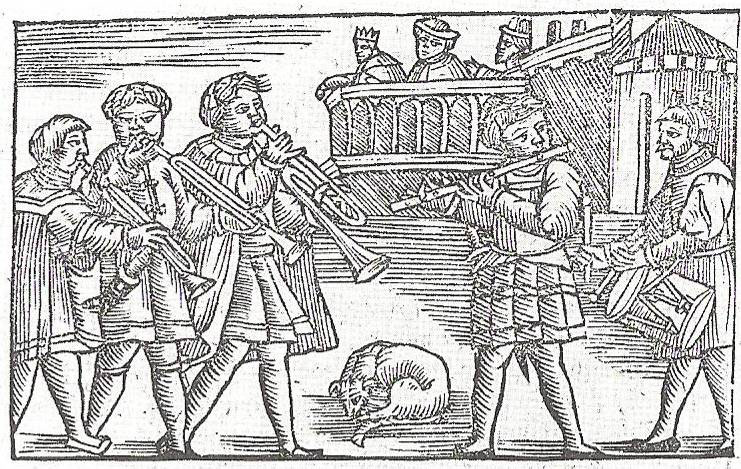
Last week in class I mentioned a tradition from Renaissance and Baroque Germany of Stadpfeifer, or civic wind bands who were employed by the city or town which had various duties, including playing from towers, for festivals and proclamations. Below is an excerpt from on online article by Dr. Steve Rhodes of Lipscomb University entitled The Baroque Wind Band:

STADTPFEIFER AND MUSIC IN LEIPZIG

Municipal wind bands played a significant role in the cultural life of German cities during the Baroque. Most of these town musicians came under the jurisdiction of the town council and were known as Ratsmusik--Rat being the German word for council. The Stadtpfeifer were the paid musicians whose primary duty was to play concerts from the town hall tower at various times of day (thus the name "tower music"). They also participated in religious and civic ceremonies, played for dances, and alerted the town to the approach of an enemy or an outbreak of fire.
The reasons for this particular German practice were at least twofold. First, the public held wind music in high esteem, deeming it a particularly noble sound. Second, Germany was still a fragmented country with many smaller kingdoms and city-states, each responsible for the social, cultural, and physical life of its people. So the Ratsmusik provided a public relations opportunity to enhance the cultural life of the community.

Winds vs. Strings
Into the middle Baroque, wind playing was still held in the highest regard. The music of brass instruments reminded the Baroque citizen of royal splendor, processions, and promotions, while string music was indicative of the dance floor or the private home
The city of Leipzig retained records of various practices of the Ratsmusiker that provide insight into the music practice of the time. By 1650, the devastating toll of the Thirty Years' War was at an end, and Germany was finally able to return to the cultivation of commerce and artistic pursuits. Leipzig was about to enjoy the greatest century of its music history. Initially four Stadtpfeifer were employed as Ratsmusiker, serving primarily as wind players.
In time three more musicians, referred to as Kunstgeiger, were hired to play the violin. Surviving records reveal much squabbling between the two groups, mostly due to the perceived inconsistencies felt by the Kunstgeiger who were subordinate to the Stadtpfeifer. The Kunstgeiger were considered apprentices to the Stadtpfeifer and were often exploited for the sake of money, having to endure an income below that of their superiors. Jealousy was the common denominator as the Stadtpfeifer, being the privileged group, received first choice for engagements outside their required duties. On occasion these two groups would band together to fight the competition presented by the Bierfiedler (fiddle players employed by beer halls). During this time string players were often considered second class citizens when compared to wind players. By 1700, another class of musician, the NeuKirchenmusiker (new church musicians) made the situation even more complicated for the city council.
Since the Stadpfiefer and Kunstgeiger were trained simply as craftsmen, the Ratsmusik lacked the respect that organists and cantors enjoyed due to their liberal arts education. Kuhnau wrote that among one hundred Kunstgeiger, there could hardly be one who could write ten words without making a mistake, and Mattheson also had little regard for them, noting their perceived conceit and lack of education.


In Leipzig the four Stadtpfeifers' most important regular function was to play daily from the tower at city hall at 10:00 a.m. and at various times during the evening. This function was known as Abblasen or Turmblasen. Johann Pezel, perhaps the most famous of these Stadtpfeifer, noted in the dedication of his Hora Decima that this custom was of Turkish or Persian origin, then hastily confirmed that it had now become a Christian tradition. Gottfried Reiche noted that this tower music was a symbol of joy and peace--no doubt a reference to the peace enjoyed due to the end of the Thirty Years' War. Since the brass instruments were provided for this function by the city, both the instruments and the music were stored in the tower. For outside employment, musicians had to provide their own instruments.
In addition to the provision of music and instruments, the Ratsmusiker enjoyed other privileges, including weekly salaries, occasional extra money, and clothing. Also, until 1717, the Stadtpfeifer paid no taxes and were given free living quarters in the Stadtpfeifergäszlein (little city musician street) where they and their families all lived together in one house. While the rank of Stadtpfeifer was a lifetime position, the downside was that upon the player's death, the surviving family could be left without means of support. Also, income was precarious during times of mourning or pestilence, as music for celebrations such as weddings was curtailed for a prescribed period of time.

On occasion, if not regularly, the Stadtpfeifer joined with the Kunstgeiger under the direction of the Cantor for church performances. Because of their versatility in playing both wind and string instruments, the combination of the two groups of musicians, coupled with student players, allowed the Cantor a respectable orchestra with which to work.

When a musician applied for a position as a Stadtpfeifer, a complete knowledge of the Stadtpfeifer instruments was usually required. These could include trumpet, cornett, trombone, French horn (in time), bombart [German for shawm], dulcian [early bassoon], flute, oboe, plus strings. Little is available today as to textbooks or written instructions concerning the craft of the Stadtpfeifer due to the secrecy surrounding the guild. Indeed, it was most difficult to reach a high level of maturity, unless fellow musicians provided the training. Not until the Ratsmusiker tradition began to die did the first known text appear, written by Johann Ernst Altenburg.

The eventual decline of the Ratsmusiker movement can be attributed to a couple of factors:

1. The steady influx of free and independent musicians gradually took its toll. These "strolling musicians", as represented by the Bierfiedler (violinists playing in beer halls and taverns, Dorfmusikunsten (village musicians), Schallmeyer (shawm players), and Hümpler und Stümpler ("bunglers and blunderers", a reference from their guild-slang), played at weddings, parties, and christening feasts. They were not subject to the limitations of the municipal prohibitions and could earn a salary throughout the whole year.

2. There was an influx of concerts and opera performances into the city. At first, the Ratsmusiker would supplement the ranks of musicians in local concerts and the nucleus of the traveling opera company. However, in the local concerts, their honored position was gradually lost as they associated professionally with the very people whom they formerly had ignored. Also, in the opera, it became awkward to expect to augment the traveling orchestra, which had already perfected the playing of increasingly demanding scores. In time only the tower playing carried on.
Examples of repertoire performed in Leipzig no doubt included Pezel's Hora decima musicorum Lipsiensium (1670) written for five-part cornett and trombone ensemble, and Reiche's Vier und zwantzig neue Quatricinia (1696), written for four-part cornett and trombones. There was certainly a wealth of other literature written during the time as evidenced by the inventory lists from 1747 which included five chorale books and 122 wind pieces written by Gottfried Reiche which are now lost.

For more information, visit the parent page A History of the Wind Band also by Dr. Rhodes.

Also see these Wikipedia entries on Alta Capella and Waits. 

Tuesday, January 19, 2016

Welcome! Spring 2016 Semester

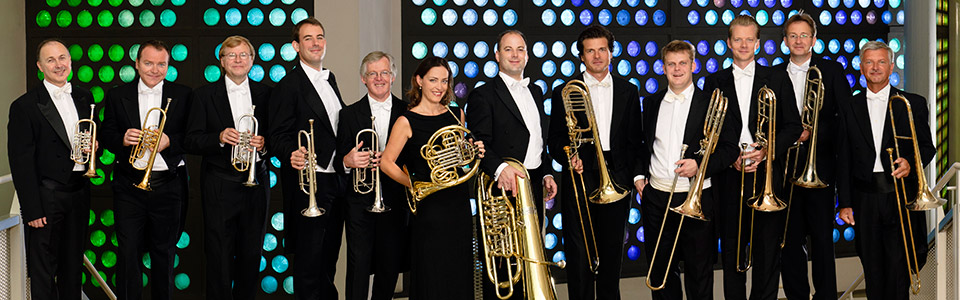
National Brass Ensemble
Welcome to ABEL Central, the course blog for Advanced Brass Ensemble Literature (MUS:5115:0001). Here you will find posts regarding our class discussions and presentations, as well as links to your own course blogs in the sidebar.

Wednesday, April 30, 2014

Brass Ensemble Music from Popular Music of North America

Today's class, "Brass Ensemble Music from Popular Music of North America" featured a variety of groups that incorporated or featured a brass ensemble within the more popular genres of Rock, Jazz/Fusion, Funk, and Soul.

These groups have made a significant impact and many of them have sold millions of albums and/or were awarded Grammys. We didn't get to a few, including the Washington Symphonic Brass Classic Rock CDHere are the related Links:


Herb Alpert Presents

Taste of Honey Video

CBS Sunday Morning Feature about Herb Alpert

Washington Symphonic Brass "Classic Rock for Brass"

Chicago
Beginnings Video

Blood Sweat and Tears
Lucretia Video

Chase
Open Up Wide Video

David Byrne and St. Vincent
NPR Video

Here is the YouTube Playlist I created called "Brass Ensembles in Popular Music":

Monday, April 28, 2014

Brass Choir Repertoire

Today we discussed repertoire that might be appropriate for a collegiate brass choir. As I mentioned, there are often several challenges to forming a brass choir; repertoire, scheduling, and instrumentation to name a few. Below is a list of suggested original works for brass choir you might consider. There are many excellent arrangements of works by Wagner, Strauss, Rimsky-Korsakov, et. al, but I focussed on original works. 


Fisher Tull - The Binding, Commendation, Liturgical Symphony, Quodlibet, Soundings, Variations on an Advent Hymn

Alfred Reed - Symphony for Brass and Percussion, Othello; Symphonic Portrait for Brass Ensemble

Aaron Copland - Fanfare for the Common Man, Ceremonial Fanfare

Karel Husa - Divertemento

Walingford Riegger - Music for Brass Choir, Op.45 (1949, Nonet for Brass (1951)

Guther Schuller - Symphony for Brass and Percussion (1950)

Raymond Premru

Joseph Turrin

Hovhaness - Link to List of Wind and Brass Music

Eric EwazenSymphony in Brass, A Western Fanfare, Grand Canyon Sinfonia, Front Range Fanfare

David Felder - Incendio, Shredder

Editions BIM - Music for Brass Ensemble (including works by Howarth, Koetsier, Plog and Sampson)


We also listened to parts of my YouTube playlist "Brass Choir Music". I have embedded the whole playlist here:

Wednesday, April 23, 2014

Obscure Brass Day

In class today, we held an"Obscure Brass Ensemble Music Day" listening session and each of you made excellent contributions. Interpreting the word "Obscure" as less frequently heard, or known by few, we came with an eclectic and innovative mix. Since most of them are on YouTube, I have curated them all onto a YouTube playlist called, of course, "Obscure Brass"

Monday, April 14, 2014

Henri Tomasi - Fanfare Liturgiques

Tuesday we listened to the Summit Brass recording of Fanfares Liturgique, by Henri Tomasi. As you heard, it is a very powerful and well-crafted composition. The names of the movements are translated below, and as we discussed, the genre seems to be an "instrumental oratorio" - that is, a sacred brass choir version of a liturgical work. Of course there is no text sung, but the orator could be represented by the trombone solo of the second movement. Note also the return of the triumphant first theme, possibly a motif for the Christ figure, returns in the final movement. I also was reminded in several passages of the works Stravinsky, Respighi, Bach, and Dukas.

This work was originally called "Fanfares Concertantes" and was part of his opera Don Juan de Mañera.
  • I. Annonciation (Annunciation is the term describing the moment when the angel Gabriel declared Mary to be the mother of God)
  • II. Evangile (Gospel, or the word of God)
  • III. Apocalypse (Apocolypse, or revelation?) Four Horsemen who are listed as Pestilence (disease epidemic), War, Famine, Death
  • IV. Procession du Vendredi-Saint (Good Friday Procession, a Christian celebration commemorating the crucifixion of Jesus)
For more information about Tomasi, go to the Tomasi page and for more listening, go to Tomasi on Naxos.


More About Tomasi and his Contemporaries

Henri Tomasi
At our recent listening session to Fanfares Liturgiques, composed in 1947 by Henri Tomasi, I commented on hearing the influence of several composers with the piece; including Copland, Respighi, Stravinsky and Dukas. Below are the dates of these composers, as well as a list of other contemporaries of Tomasi's for comparison.

Henri Tomasi (1901-1971)
Aaron Copland (1900-1990)
Ottorini Respighi (1879-1936)
Igor Stravinsky (1882-1971)
Paul Dukas (1865-1935)

OTHER CONTEMPORARIES:
Stockhausen, Shostakovich, Britten, Crumb, Hindemith, Babbitt, Barber, Ives, Prokofiev, Varese, Boulez, Arnold

FAMOUS COMPOSITIONS OF 1947-1952:
4'33" by John Cage - 1952
Trumpet Concerto by Arutiunian
Knoxville: Summer of 1915 by Samuel Barber


TOMASI BIOGRAPHICAL SKETCH:
(from http://www.henri-tomasi.asso.fr/en/index)

I. A young Corsican from Marseille (1901-1920)

1901 – August 17. Henri Tomasi, the first son of Xavier Tomasi and Joséphine Vincensini, both from La Casinca, Corsica, is born in a working class neighborhood of Marseille called ‘La Belle de Mai’, at 17, rue Bleu (now called Rue Clovis Hugues).

1905 – The family moves to Mazargues, where Henri’s father has a job as a postal worker. Himself an amateur flutist, Xavier sends his 5-year-old son to musical theory lessons.

1908 – Henri enters the Conservatoire de Musique de Marseille. He wins first prize for musical theory when he is ten and first prize for piano at thirteen. His father takes him to visit upper class families where, introduced as a musical wunderkind, he feels ‘humiliated to be on show like a trained animal.’

1913 – The family moves back to Marseille, 5, Rue de la Loubière, next to the Notre-Dame du Mont church. Whenever he can, the boy skips classes at the conservatory and goes swimming or reads Les Pieds Nickelés in secret in response to the strictness of a father who has brushed aside his dream of becoming a sailor.
Every summer he travels to Corsica where he learns traditional Corsican songs from his grandmother.

1916 – First prize in harmony theory shared with Zino Francescatti [the celebrated violonist], who becomes his friend. As WWI has delayed his entry into the Conservatoire de Paris, he begins earning money in Marseille as a pianist. He plays in the most diverse settings imaginable: stylish, well-known establishments such as l’Hôtel Noailles or the ‘La Réserve’ restaurant on the cliff road; the brothels ‘Chez Aline’ and ‘Chez Adèle’; and the first movie houses, ‘Le Femina’ and ‘Le Saint-Ferréol.’ His gift for composition is obvious when he improvises on the keyboard. The earliest Charlie Chaplin films and ‘The Mysteries of New York’ awaken his interest in cinema.
Jean Molinetti, life-long best friend and confidant, recalls having heard him play one of his first pieces, ‘Au Bord du Djedi’, during this period.

II – Studies and early accomplishments in Paris (1921-1938)

1921 – Arrival in Paris and enrolment in the Harmony Class at the Conservatoire de la Rue de Madrid. He is a brilliant student – “He showed up with a fugue a week. He was indefatigable – an inveterate workaholic!” his friend Maurice Franck would say. Although he has a scholarship from the municipality of Marseille and is under the patronage of the lawyer Maître Lévy-Oulman, he is obliged to continue ‘doing the job’, that is, playing piano in cafés and cinemas, in order to get by.

1925 – His first piece, a wind quintet called Variations sur un Thème Corse, wins the Prix Halphen.

1927 – He meets Odette Camp at the Opéra-Comique. The 18-year-old, a student at the Beaux-Arts, has come to discover Puccini’s La Bohème. This is also the year when Henri Tomasi receives the highest possible honors: a Grand Prix de Rome and a First Prize for Orchestra Conducting, awarded unanimously.

1928 – He begins his career as an orchestra conductor with the ‘Concerts du Journal’, and writes a piece for piano and violin, Paghiella, first performed by Zino Francescatti.

1929 – In Loretto di Casinca, Corsica, where his family’s roots are, he composes Cyrnos, a symphonic poem for orchestra and piano. According to Florent Schmitt, “Cyrnos contains original ideas, inspiration and, lastly, a dash of lyricism, so rare amongst young people nowadays.”
On October 30, in Paris, he weds Odette Camp, who is to become an accomplished artist. They settle down near Pigalle, at 24 Rue Victor Massé.

1931 – He conducts the ‘Radio-Colonial Orchestra’ founded by Julien Maigret during the 1931 Colonial Exhibition in Paris, thus becoming one of the first radio conductors and a pioneer of ‘radiophonic music’. His renown is secured by the public appreciation of Tam-tam, a symphonic poem for Choir, Solo and Orchestra.

1932 – Tomasi becomes a founding member of the ‘Triton Group of Contemporary Music’ along with Honegger, Milhaud, Poulenc, Prokofiev, and others. The Honorary Members include the 20th century’s most illustrious composers: Ravel, Stravinski, Schoenberg... He composes a new work that reinforces his renown, Vocero, a choreographed symphonic poem with a Corsican perspective.

1933 – Chants Laotiens for baritone or contralto and orchestra or piano.

1935 – Quatre Chants de Geishas for soprano and orchestra or piano. His recording of Gluck’s Orphée featuring Alice Raveau is awarded the Grand Prix du Disque.

1936 – Increased activity as a conductor in Paris and the rest of France.

1937 – He writes his first work inspired by Provence, southeast France: a ballet called Les Santons. With its libretto by René Daumesnil, the piece, first performed at the Opéra de Paris on November 18, 1938, is a great success. In 1946 it is recorded on film for posterity.

1938 – He composes the Ballade pour Saxophone Alto, first performed by Marcel Mule in 1939.

III – Second World War – global and personal crises (1939-1944)

1939 – In the midst of an existential crisis, he yearns to get away from it all. He boards – alone - a cargo ship destined for Dakkar but the Second World War breaks out, and as soon as Henri arrives in Morocco he has to return to France. He is drafted on August 15 and joins the Chasseurs Alpins at the fort of Villefranche-sur-Mer where he is named Head of the Marching Band.

1940 – Discharged, he once again takes up his conductor’s baton at the Orchestre National, which has been expatriated to Marseille. Reunion with his family and his wife Odette who leaves Paris to join him. The couple settles down on the cliff road, 151 Corniche, where they frequently entertain. Their friends and guests include musicians such as Etienne Baudo and Joseph Alviset, the writer Roland Dorgelès, the photographer Gaston Manuel and many others.

1941-42 – The Symphonie en ut (C major), conducted by Charles Munch, heralds a new period, both in his way of thinking and his musical compositions which reflect a new breadth. “The battle between the instinct of passion and mystical yearnings – the sufferings of humanity – the final affirmation of enduring joy.” He begins spending time at the Monastère de la Sainte-Baume (which is Dominican at the time) in order to devote all his energy to creating the opera that would become his chef-d’oeuvre, Don Juan de Mañara, based on the fine text by poet O.V. de L. Milosz.

1943 – His life is divided between Marseille and Sainte-Baume. He and a young woman fall in love, but as there is no hope of establishing a relationship, he spends more and more time in religious retreats. La Presse wonders “whether Tomasi is going to take orders”. Odette, his wife, thinks that he had better not, and she manages to transform the meeting where Henri has come to ask for a divorce into a reconciliation...

1944 – Birth of their son, Claude Tomasi. Henri finishes composing his Requiem pour la Paix, dedicated “To the martyrs of the resistance movement and all those who have died for France.” At the end of the war, the discovery of the concentration camps and Hiroshima leads the musician to reject all faith in God and religion, and he sets his Requiem aside. It isn’t until 1996 that the musicologist Frédéric Ducros-Malmazet rediscovers the opus and it is finally recorded. Played by the Orchestre Philharmonique de Marseille and the regional choir of Provence-Côte d’Azur under the direction of Michel Piquemal, the requiem is undeniably a masterpiece.
IV – Parallel Careers throughout Europe (1945-1958)

1946 – Raoul Gainsbourg appoints him Directing Conductor of the Opéra de Monte-Carlo, heralding a brilliant and intense new period of activity guiding orchestras throughout France, including the Orchestre National, the various radio orchestras, and Concerts Pasdeloup, Colonne and Lamoureux. His activity in the rest of Europe kicks off with a triumphant performance conducting a Debussy-Ravel program with the Concertgebow Orchestre in Switzerland. He’ll be invited back several years in a row (the Holland Festival).

1947 – First performance in Monte-Carlo of what will become one of his most famous works. Originally called Fanfares Concertantes, the opus will be played world-wide in its integral form under the name Fanfares Liturgiques. Its four movements, Annonciation, Evangile, Apocalypse and Procession du Vendredi Saint, are part of the opera Don Juan de Mañara.
First season with the Festival de Vichy where he will conduct until 1955.

1948 –Henri Tomasi writes what will become his most popular composition, Le Concerto pour Trompette. It will be played and recorded by some of the finest musicians of the time: L. Vaillant, M. André, P. Thibaud, W. Marsalis, E. Aubier...

1949 – Concerto de Saxophone: first performed in Paris on March 2, 1950, by Marcel Mule. Tomasi himself conducts the Orchestre National.

1950 – Concerto pour Alto.

1951 – Divertimento Corsica.
Based on the novel by Pierre Benoit , l’Atlantide, with libretto by Francis Didelot, is a choreographed operatic drama that has an exceptional destiny. It will be performed over eighty times in France (twenty at the Palais-Garnier in Paris), Germany and Belgium.

1952 – In February a serious automobile accident resulting in a broken leg interrupts his conducting career for several months.
He writes his Noces de Cendres (The Ashen Wedding), an anti-war ballet, and is awarded the Grand Prix de la Musique Française by the SACEM.

1953 – The lyrical drama Sampiero Corso, with libretto by Raphaël Cuttoli, is first played in May,
1956, in Bordeaux starring Régine Crespin. It is performed at the Holland Festival the same year.
There are initial signs of deafness in the right ear, a malady that will deteriorate until his hearing is definitively lost in that ear.
He declines an invitation to join the Légion d’Honneur, “until such time as a Conservatory is founded in Corsica.”

1955 – Triomphe de Jeanne, an oratorio, with text by Philippe Soupault. To mark the five hundred year anniversary of Joan of Arc’s rehabilitation, it opens in Rouen in 1956 featuring Rita Gorr and Ernest Blanc.

1956 – April 12 heralds the triumphant world premiere in Munich of Don Juan de Mañara.
He writes the Concerto pour Clarinette and the Concerto pour Trombone.

1957 – Tomasi leaves conducting both in order to devote his energy entirely to composing and also because of various physical problems.

1958 – The overwhelming popularity of l’Atlantide, performed at l’Opéra de Paris, makes Tomasi the scapegoat of the ‘musical avant-garde’, particularly sectarian at the time. It is during this same period that misgivings about his former way of thinking and use of language lead him to a new phase of inspiration and creativity.

V – Oblivion and metamorphosis (1959-1971)

1959 – Le Silence de la Mer, a lyrical drama in one act based on a text by Vercors, marks the beginning of a phase where the very soul and history of the 20th century would be embodied in powerful opuses with a decidedly contemporary slant. This chamber opera, recorded at the ORTF by Georges Prêtre, will first be played in germany at the Opera of East Berlin in 1966.

1960 – Grand Prix Musical awarded by the city of Paris.

1961 – Ulysse ou le Beau Périple (Ulysses or the Beautiful Journey), ‘a literary and musical diversion’, is composed based on a text by Jean Giono.

1962 – Tomasi’s Concerto pour Violon (’Ulysses’ Journey), dedicated to and first perfomed by Dévy Erlih, is described as “a piece of fabulous, epic expressionism” by the critic from “Le Monde”, Jacques Lonchampt.

1963 – La Chèvre de Monsieur Séguin, a lyrical tale based on A. Daudet’s narrative, is recorded starring the well-known actor Michel Galabru.

1965 – Concerto pour Flûte (Printemps). The opening performance in Marseille, January 1966, features Jean-Pierre Rampal and the Orchestre des Concerts Classiques conducted by Serge Baudo.
His Éloge de la Folie (ère nucléaire) – ‘In Praise of Madness (the nuclear era)’, based on a piece by Erasmus, is described as “the interplay of satire, lyricism and choreography”. This opus, the last he creates for theater, echoes the testament that Tomasi will first write in 1966: “E finita la commedia! Peace, finally, on this stupid planet!”

1966 – He composes Retour à Tipasa, “a secular cantata for spoken voice, male chorus and orchestra”; text by Albert Camus. The opening performance won’t be held until after his death at the Abbaye de Saint-Victor on April 25, 1985. The piece goes beyond the absurd to celebrate communion with the world and solidarity among men. “In the heart of the winter I finally realized that part of me was an invincible summer. Oh light! Oh vibrant light!”.
His Highlands’ Ballad, a concerto for harp, will be recorded in 1985 by Marielle Nordmann and the Orchestre de Chambre des Solistes de Marseille under the wand of Reynald Giovaninetti.

1967 – Tomasi’s indignation with political and social injustice is transcribed into the core of his compositions, especially his Symphonie du Tiers-Monde (Third World Symphony), based on a text by Aimé Césaire and dedicated to Hector Berlioz.

1968 – Chant pour le Vietnam, a symphonic poem inspired by a texte by Jean-Paul Sartre, is written to accompany a photo exhibition by Roger Pic.
Concerto pour Violoncelle. - Tomasi does not obtain the authorization to write musical adaptations of Ionesco’s The Chairs or The King is Dying.
His Concerto de Guitare à la Mémoire du Poète Assassiné, F.G. Lorca, originally conceived for the Duo Presti-Lagoya’s two guitars, is rewritten for guitar solo after Ida Presti’s death.

1969 – He holds a series of interviews with his son, Claude, called “Autobiography with a tape recorder.”
On November 1 he is afflicted with pulmonary edema. After ten months of convalescence, Henri Tomasi will finally be able to see the Vieux-Port de Marseille for the last time in September, 1970. “Before the final breakdown, I must see the Mediterranean, my sea. Vive mare nostrum!”

1970 – “Back in exile” in Paris, he adds the finishes touches to a Concerto for Contrabasse and rereads Hamlet with the idea of putting the plot to music. Time runs out, and he will only be able to finish the a cappella score of the twelfth of his 18 Chants Populaires de l’Île de Corse.

1971 – On the morning of January 13, he dies suddenly and peacefully in his apartment in Montmartre. In accordance with his last wishes, he is buried under the Mediterranean sky in his wife’s family tomb in Avignon. The simple ceremony, “without flowers or wreaths, nor civil or religious ceremony,” is attended solely by family members and Jean Molinetti.
In 2001, to celebrate the centennial of his birth, his ashes are moved to the village of his forebears, Penta di Casinca, in Corsica.
Thursday, April 03, 2014

Group Listening Session

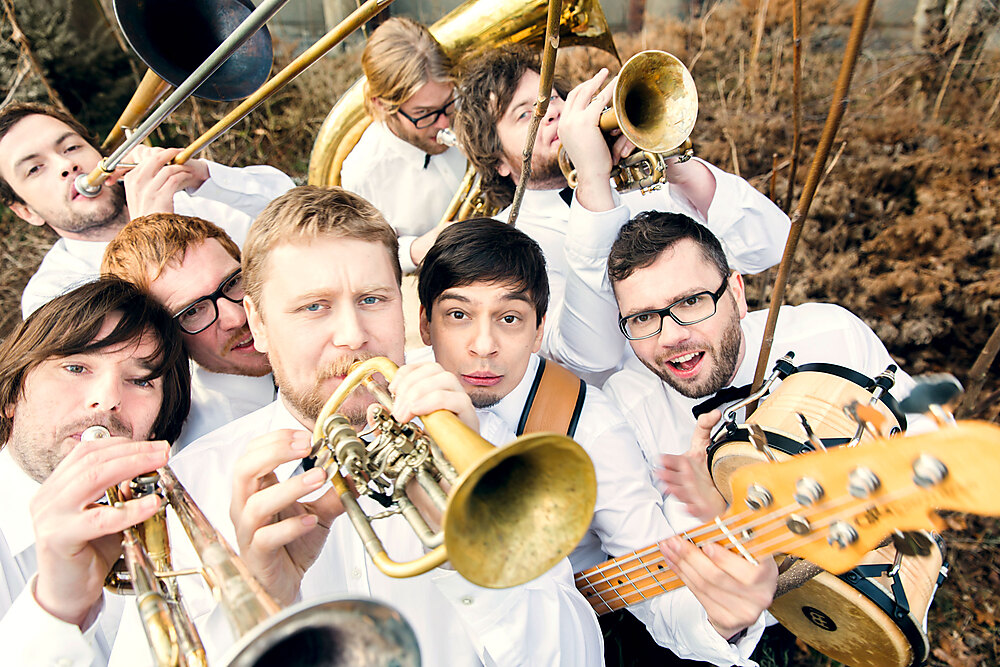
La Brass Banda
Yesterday morning we all contributed to a group listening session. Here is what we heard:

1. "Insomnio" by Jon Nelson for large brass ensemble. The group/CD name is "Metalofonico" and the personnel included members of the Meridian Arts Ensemble, the Atlantic Brass Quintet plus Greg Evans and Jeff Scott on horn; Stephan Sanders, Jim Miller and Miles Anderson on trombone plus percussion. Here is a link with more information about the recording.

2. Ben Yates played two recordings of the Chicago Symphony Brass section (Gabrieli and Berlioz). Here is a grooveshark link where you can listen to the tracks.

3. Ben Drury showed a video of Kudt Brass performing Don Quichottisen by Jan Koetsier (Op. 144) Watch the rest of the video here.

4. Randil played a recording of a work for brass band by Paul Lovatt-Cooper called "Enter the Galazies" by the Corey Band. Here is a video.

5. Chris played a video of the Vienna Horns performing/recording of an arrangement of Back to the Future from their CD "Director's Cut" (composed by Alan Silvestri and arranged by ?)

6. Zsolt presented a video of a unique popular brass band from Bavaria called "La Brass Banda". Here is a link to the video.

Thank you all for your contributions to this interesting and diverse listening session! 

Monday, March 31, 2014

Symphony for Brass by Malcom Arnold

Sir Malcolm Arnold (left) with Denis Egan
on natural trumpets in 1946
Today we listened to Sir Malcom Arnold's Symphony for Brass as recorded by the Philip Jones Brass Ensemble. The piece was written in 1978 with the PJBE standard instrumentation of four trumpets, one horn, four trombones and one tuba. We discussed some theories of why this instrumentation came about. It may have had something to do with the fact that the PJBE originated as a brass quintet.

Arnold was born in Northampton, England in 1921 and after hearing Louis Armstrong play, he decided to learn the trumpet at age twelve. He attended the Royal College of Music and studied trumpet with Gordon Jacob. In 1957, Arnold won an Academy Award for the music to epic film The Bridge on the River Kwai.

According to Music Academy Online:
Malcolm Arnold moved to Ireland in 1972, where he reveled in the lush scenery and lively Celtic music. Here, however, his behavior became increasingly erratic and, in 1977, his second marriage collapsed and he returned to England, exhausted and unable to work for several years. Significant works eventually emerged during this unhappy period, such as the Trumpet Concerto, Symphony for Brass and the Eighth Symphony.
Oral history of Glyndebourne opera

Here is a link to the book The Odyssey of the Philip Jones Brass Ensemble by Donna McDonald available at Editions BIM.

Sunday, March 23, 2014

March Fourth Marching Band

At the end of the soundtrack for the Pixar animated film, Monsters University is a funky and upbeat tune called "Gospel" by the group March Fourth Marching Band. Check out the sound at this YouTube link.

Like a lot of brass bands we've heard, their group also includes saxes and percussion, but M4 is so much more. They have added elaborate costumes, singers and dancers to create an innovative circus-like atmosphere. Here is a description from their website:
MarchFourth Marching Band (M4 to its fans) is a kaleidoscope of musical and visual energy that inspires dancing in an atmosphere of celebration. Aside from their marching band themed costumes, as well as the 5-piece percussion corps and 6-part brass section, M4 is far from a “marching band” in any traditional sense (though this group of 15-20 has been known to parade down Main Street before taking the stage). M4 is anchored by funky electric bass and has been evolving into a more guitar- and vocal-driven musical experience. The show will take you on a journey from the swamps of Louisiana to the gypsy camps of eastern Europe to the African jungle by way of Brazil, echoing the deepest grooves of American funk, rock, and jazz then boiling it all together in cinematic fashion with high-stepping stilt-acrobatics and dazzling dancers. This genre-busting, in-your-face experience is not to be missed! What began as a Fat Tuesday party in Portland, OR. on March 4th 2003, has since become one of the nation’s best live touring acts.

Monday, March 03, 2014

Citing Online Sources

All of you did a great job on your recent papers, but I noticed that not all of you knew how to list online sources in your bibliographies. Here is some advice from the Tippie College of Business website article:

Web versions of printed material

Because web sources are time-sensitive, meaning that web content can change day by day, it is important to include the day of retrieval and the URL from which you quoted the material. You include this in a retrieval statement.
The format for online versions of print publications should basically follow the same format as above, meaning if you’re referencing an online book, you should follow the book format with the addition of the retrieval statement. If you’re referencing an online periodical, you should follow the periodical format with the addition of the retrieval statement.
Note that you should not break the Internet address of the link, even if it requires its own line. Very long URLs, such as those that occur when using an online database, can be shortened by removing the retrieval code. (The retrieval code usually consists of a long string of unintelligible letters and numbers following the end point “htm” or “html.” Remove everything that occurs after that point to shorten.)
Author. (Date of Internet Publication—could be more than a year) “Document Title.” Title of Publication. Retrieved on: Date from Full Web Address, starting with http://

Grant, Linda. (January 13, 1997) “Can Fisher Focus Kodak?” Fortune. Retrieved on August 22, 1997 from www.pathfinder.com/@@ctQzLAcAQQIIP/fortune/1997/970113/kod.html
The above is just one example of citing online sources. There are more extensive bibliographic guidelines at www.bedfordstmartins.com/online/cite6.html.

Although I asked for double spacing, which allows the grader room for correction, extended quotations should be single-spaced, since we should assume their are no errors in previously published text. Some sources even suggest indenting block quotes to further identify non-original material.

The University of Iowa Libraries has a good online resources at http://guides.lib.uiowa.edu/research_papers

Wednesday, February 05, 2014

Listening Presentations

Today we heard our first student listening presentation presented by Chris. He did a good job and we heard some great brass ensemble music. Just a reminder, make a point of knowing basic information about the music you present, such as dates. Look up and list the dates of the recordings, dates of the compositions, birth/death dates of composers and any other facts you think might be of interest.

Saturday, February 01, 2014

Civil War Brass Band Photo

Last week I discussed regimental brass bands playing Saxhorns during the Civil War. I just ran across this 1864 photo of one of the Federal/Union Army Bands playing on top of Lookout Mountain, near Chattanooga, South East Tenn.
Courtesy Tennessee Artifacts History Facebook page via Jay Krush, tubist with the Grammy-award-winning Chestnut Brass Company.


Wednesday, January 29, 2014

Historic Brass Ensemble Listening Session

The English Cornett and Sackbutt Ensemble
Today we heard recordings of various brass ensemble music from the Renaissance through the 19th Century. Here is the list:
  1. La Feliciano a 4 by Adriano Banchieri - English Cornett and Sackbutt Ensemble
  2. La Bignani by Giovanni Cavaccio - English Cornett and Sackbutt Ensemble
  3. Canzona I by Paul Peuerl - Atlantic Brass Quintet
  4. Canzona - Samuel Scheidt - Four of Kind
  5. Canzona Duodecimi Toni by Giovanni Gabrieli - Combined brass sections of Philadelphia/Cleveland/Chicago
  6. The New Year's Gift by Anthony Holborne - Atlantic Brass Quintet
  7. Les Plaisirs de le Chasse (traditional hunting horn call) - Le Rallye-Cor de Montmélian
  8. Brass Quintet by Alexander Aliabev - Montanus Brass Quintet
  9. Ellen Bayne Quickstep by G. W. E. Friedrich - American Brass Band Journal, Empire Brass and Friends
  10. Fanfare from La Peri by Paul Dukas - Grand Ensemble de Cuivre et Percussion de Hauts de France

Tuesday, January 21, 2014

Day One - Spring 2014

Welcome to Advanced Brass Ensemble Literature. Instead of using ICON, please refer to this website for information regarding the class. Each of you will be maintaining a course-related blog and links to those blogs will be located in the right sidebar.

Below are direct links to Google Documents for this course:
Please print them out, refer to them, and keep them in your course notebook binder.


Tuesday, April 16, 2013

Meridian Brass Marketing

Meridian Brass
In our last class, we discussed how professional brass ensembles market and publicize themselves. I just discovered a very unique marketing technique by the Meridian Brass (No, it's not the Meridian Arts Ensemble). The strategy of a "theme" recording, combined with social media and interactive online multimedia creates an interesting advertisement for their next recording. You can view it here.

Monday, April 08, 2013

Blog Post Brainstorming

There are only two more weeks remaining for your blog assignment. Here are some ideas we discussed in class for blog posts:
  1. Blog about a work for brass ensemble that you like that we did not listen to or discuss in class. If you would nominate it for a "landmark work" explain why.
  2. Find a mediocre performance of a brass ensemble work on YouTube and then write a "virtual coaching" post. Be sure to provide positive feedback as well as constructive criticism.
  3. Compare a  brass ensemble arrangement to the original work. Compare two recordings of the same arrangement.
  4. Discuss your experiences organizing a brass ensemble tour and share what you learned on the tour.
  5. Compare and contrast two pieces from the same time period, country, or composer.
  6. Write a review of a book or journal article related to brass ensemble literature, performing, or a related musical issue.
  7. Share what you know about composers who have written for brass ensemble for a particular region of the world.
  8. Get inspired by read each other's blog posts and create a post of your own on a similar topic.
  9. Give us a preview of your upcoming listening presentation.
  10. Read some of the older posts on ABEL Central and write a post inspired by a class form a previous year.

Monday, March 04, 2013

Behind the Scenes of Victor Ewald's Complete Quintets

Two of my colleagues in the Atlantic Brass Quintet recently recorded the complete Ewald Brass Quintets with Mark Gould, Dave Taylor, and Chris Komer. Here's a peek...


Tuesday, January 29, 2013

David Byrne, of Talking Heads fame and St. Vincent have teamed up and created a very unique pop album called Love This Giant that is centered around a brass band. The writing is very unique, and not at all like your typical rock horn section writing. It is minimalist in nature and the counterpoint and instrumentation is very complicated. Here is a clip from their recent appearance on David Letterman. Wikipedia has a link listing the personnel for the original recording.

Tuesday, January 22, 2013

Berlin Philharmonic Brass

Welcome Spring 2013 students to Advanced Brass Ensemble Literature!